


Think Like a Visitor Before Thinking Like AI
One of the biggest mistakes businesses make is trying to optimise their websites only for algorithms.
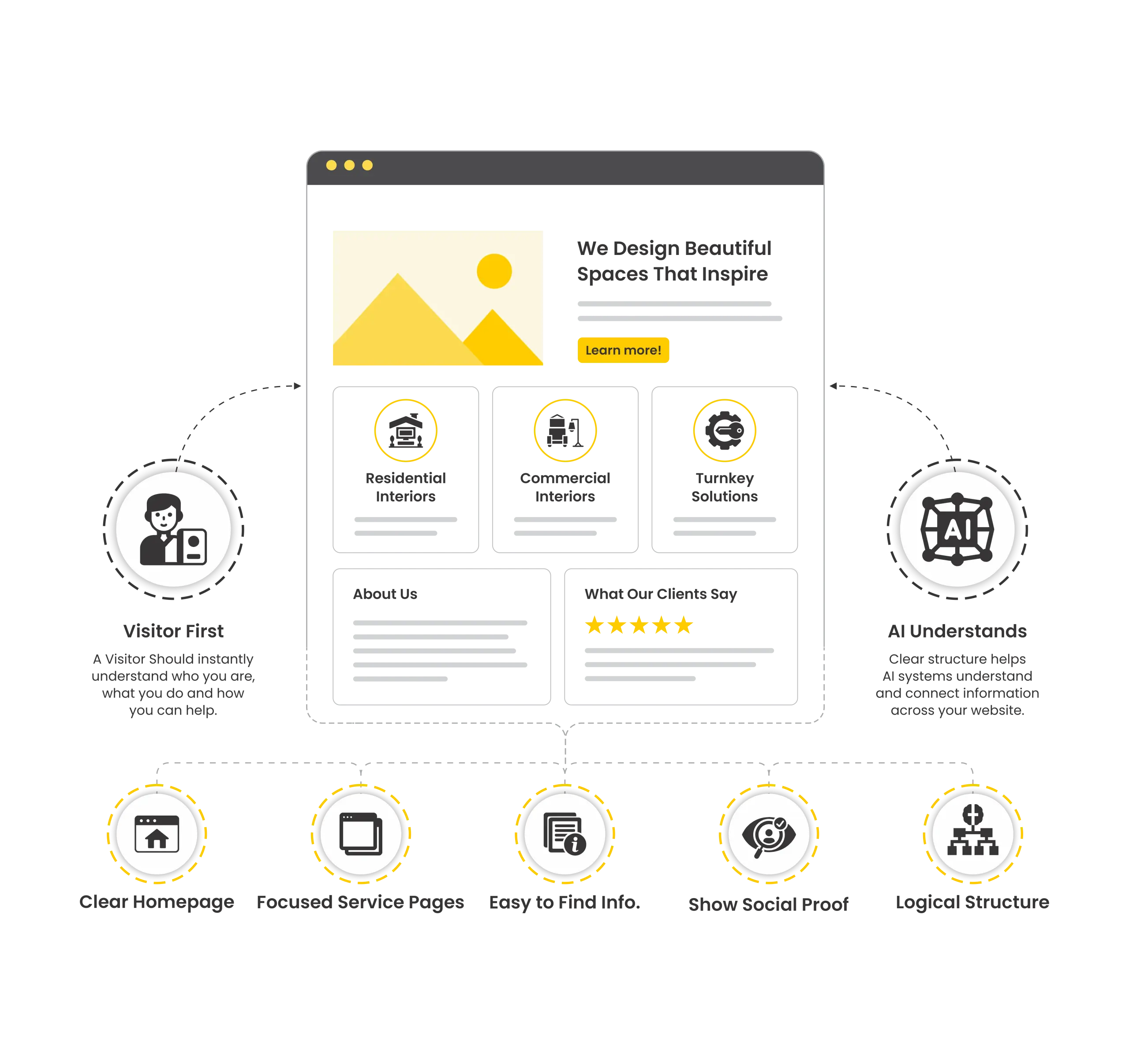
Imagine someone visits your website for the first time. Within a few seconds, can they understand who you are? Can they identify your services? Can they easily find answers to their questions?
If the answer is no, AI systems will probably struggle too.
A good website structure begins with clarity. Your homepage should explain your business in simple words. Service pages should focus on one service at a time instead of trying to cover everything at once. Important information such as contact details, locations, testimonials, and business credentials should be easy to find.
For example, if you run an interior design company, having separate pages for residential interiors, commercial interiors, and turnkey solutions makes it easier for AI to understand your expertise. If everything is mixed into one long page, the message becomes less clear.
Why FAQs Are Becoming More Valuable
They don’t search using short phrases like:
“best architect Ahmedabad”
Instead of opening ten browser tabs and searching for information manually, buyers can ask AI tools detailed questions and get clear answers within seconds. AI platforms summarize information from different sources and help users narrow down their options much earlier in the buying journey.
Instead, they ask:
“Can ChatGPT recommend an architect in Ahmedabad for luxury bungalow design?”
This is why FAQs have become incredibly important.
FAQs naturally match the way people ask questions.
A good FAQ section doesn’t just improve SEO. It gives AI direct answers that can be referenced when generating responses.
However, many businesses still treat FAQs as an afterthought.
Short answers such as:
Do you offer website development?
Yes.
don’t add much value.
A more detailed answer is far more useful:
Do you offer custom website development for businesses?
Yes, we design and develop custom websites for businesses across different industries. Our services include UI design, responsive development, CMS integration, SEO optimization, and ongoing support after launch.
The goal is not to stuff keywords into FAQs. The goal is to answer questions the same way you would if a customer asked you directly.
This type of answer feels natural, helps visitors, and gives AI more context about your expertise.
Service Pages Need Real Information
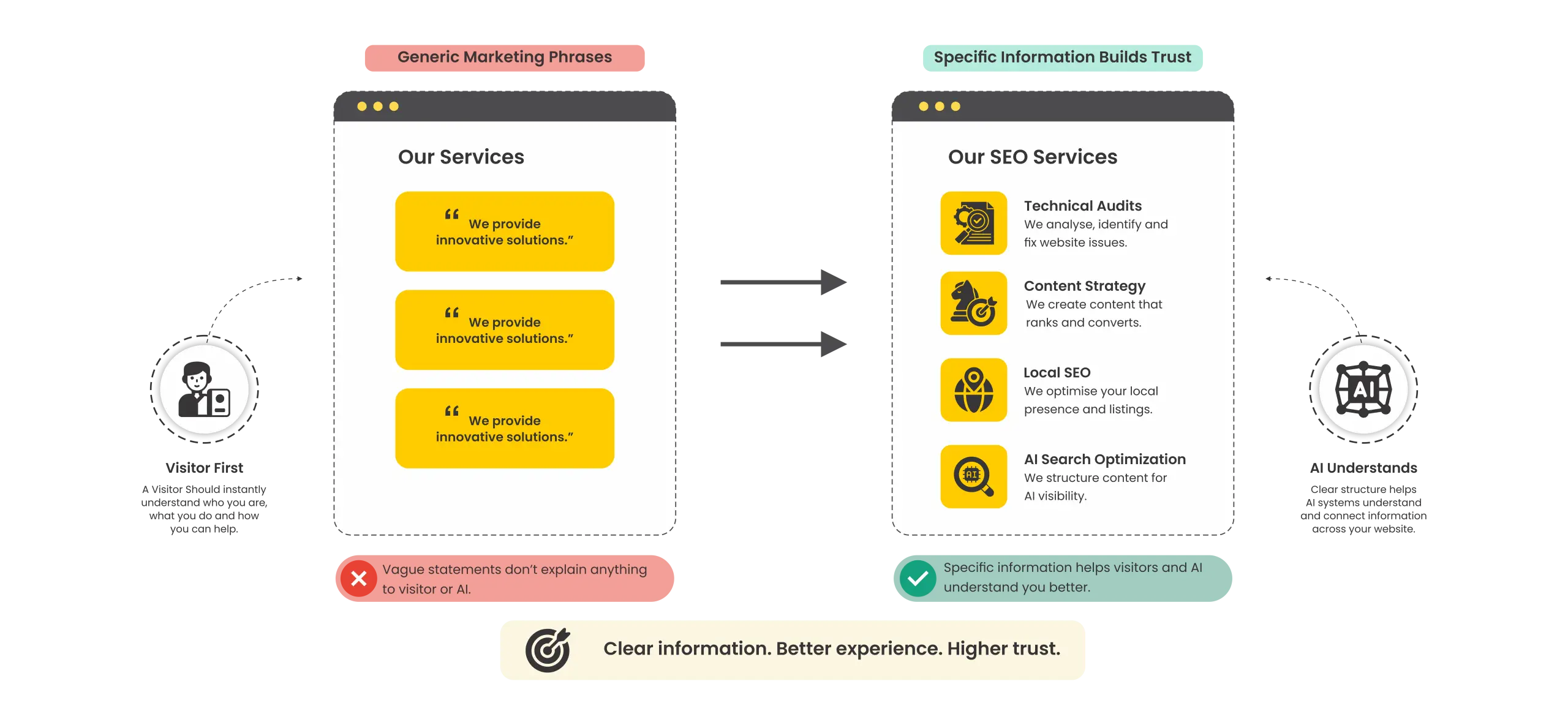
“We provide innovative and world-class solutions.”
“We are a leading company in the industry.”
- The problem is that these statements don't explain anything.
- Visitors want specifics.
- AI wants specifics too.
- If you provide SEO services, explain how your process works. Talk about technical audits, content strategy, local SEO, or AI search optimization.
- If you're a manufacturer, discuss your production capabilities, quality standards, and industries you serve.
- If you're a consultant, explain the challenges you help businesses solve and share examples wherever possible.
- Specific information builds trust.
- When AI systems analyse websites, they look for expertise and context. Detailed service pages provide exactly that.
- Businesses that explain their work clearly are more likely to be referenced than businesses that rely on generic marketing language.
Content That AI Loves Is Surprisingly Simple
In reality, AI prefers content that people already enjoy reading.
Articles that answer questions.
- Detailed guides
- Case studies
- Comparison pages
- How-to tutorials
- Industry insights
- What matters most is usefulness
“How can I improve my website for AI search?”
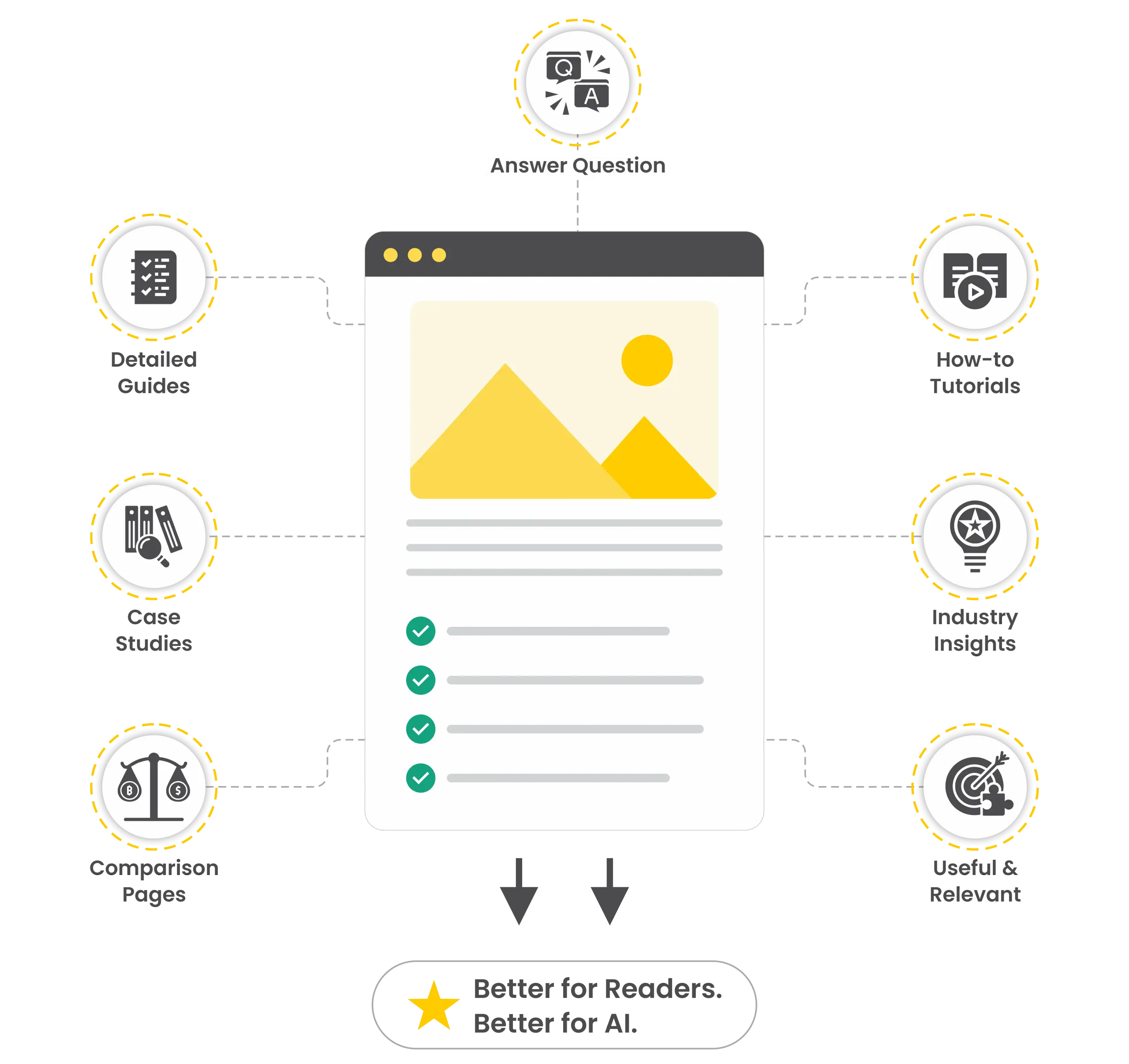
An article that explains the topic clearly, provides examples, and answers common questions has a much better chance of being referenced than a page filled with promotional language.
AI systems are designed to identify useful information.
This means businesses should focus less on impressing search engines and more on helping readers.
Simple explanations often outperform complicated ones.
Clear language builds trust.
And trust is becoming one of the most important ranking factors in AI-driven search.
The Role of Schema in AI Search
In simple terms, schema is structured information that helps search engines understand your website.
Think of it like adding labels to your website.
With schema, you’re giving them additional context.
Does schema guarantee you'll appear in ChatGPT or Google AI Overviews?
No.
But it helps search engines understand your website more accurately, which is always beneficial.
When combined with high-quality content and strong SEO fundamentals, schema becomes an important part of website optimization for AI search.
AI Search Rewards Expertise and Credibility
They prefer businesses that demonstrate real expertise.
Customer reviews matter
Case studies matter
Industry recognition matters.
Consistent business information matters
“How do I rank in AI search?”
“How do I become the most helpful and trustworthy source in my industry?”
The second question usually leads to better long-term results.